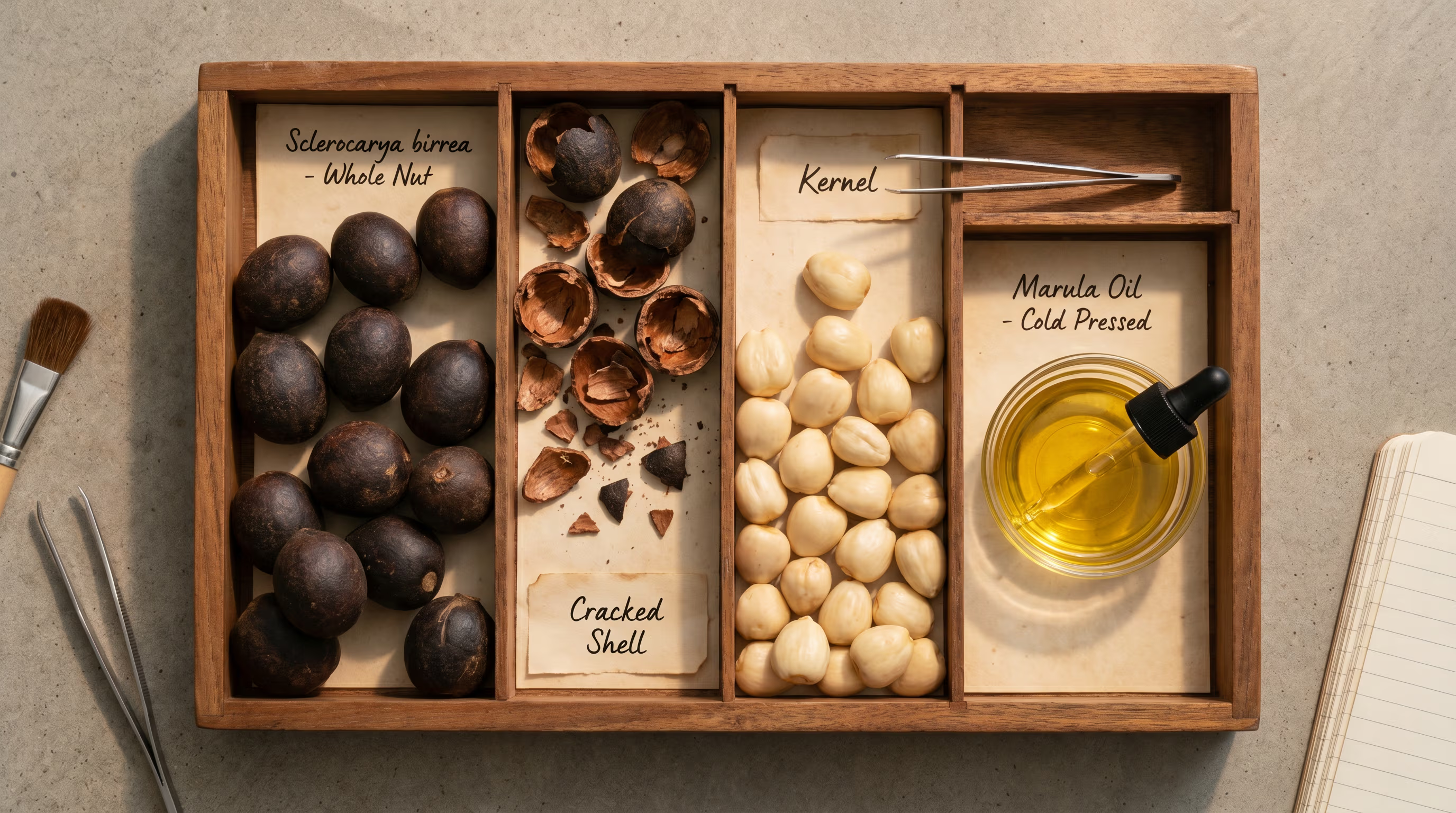
The marula tree (Sclerocarya birrea) does an unusual thing in winter. It drops most of its leaves, holds onto its fruit, and puts that fruit through a slow ground fermentation that produces — eventually — small, oval drupes the colour of unripe lemons, with a flesh that is sweet and acidic in roughly equal measure. Elephants eat them. Baboons eat them. Humans have been eating them, brewing them into a low-alcohol beer, and pressing oil from the kernels for at least 12,000 years, judging from archaeological evidence at the Pomongwe Cave in Zimbabwe.
What the kernel produces, when cold-pressed at a low enough temperature to keep the seed proteins intact, is one of the more chemically distinctive vegetable oils in the cosmetic supply chain. We use it as the dominant lipid base in three of our nine launch formulations. This is the long version of why.
The fatty acid profile
Cosmetic-grade vegetable oils are characterised by their fatty acid composition. The two relevant numbers for skin care are the proportion of monounsaturated fatty acids — primarily oleic acid — and the proportion of polyunsaturated fatty acids, primarily linoleic acid. Oleic-dominant oils slip well across skin and feel rich. Linoleic-dominant oils penetrate faster, sit lighter, and contribute more directly to barrier function because linoleic acid is a constituent of the skin’s natural ceramide structure.
Marula oil is unusually oleic-dominant. The literature reports values between 70% and 78% oleic acid, depending on the source population of trees and the pressing method. Linoleic acid sits between 4% and 7%. This is a profile that puts marula closer to olive oil than to safflower or sunflower in cosmetic terms. The implication is sensorial — marula feels rich, glides easily across skin, and absorbs over a slightly longer window than a linoleic-dominant oil. It is good for the body, where slip and slow absorption are usually what you want.
The minor components are where marula gets interesting. The oil contains a naturally high tocopherol content — vitamin E, in its alpha and gamma forms — at concentrations between 200 and 500 milligrams per kilogram of finished oil. This is high enough to give marula intrinsic oxidative stability without added synthetic antioxidants, which is unusual for a cold-pressed seed oil. It also contains trace amounts of phytosterols, primarily beta-sitosterol, which have demonstrable anti-inflammatory activity in topical formulations.
These are credentials. None of them, on their own, would be enough to build a product around. The question that mattered for us, when we were designing the formulations, was whether the published clinical evidence supported the chemistry — whether marula actually does, on real skin, what its profile suggests it should.
The 2015 trial
The first randomised controlled trial of topical marula oil on human skin was published in 2015 in the Journal of Cosmetic Dermatology, by a research team led by Lerato Komane at Tshwane University of Technology in Pretoria. The trial was not enormous — fifty women, ages 18 to 60, randomised to either marula oil or a vehicle control — but it was rigorously designed. Hydration was measured by corneometry, transepidermal water loss by tewameter, and skin elasticity by cutometer. Measurements were taken at baseline, 30 minutes, two hours, and after 28 days of twice-daily application.
The results were unambiguous. At thirty minutes, marula oil increased skin hydration by approximately 16% compared to the control. By 28 days, the increase was 21%. Transepidermal water loss decreased by 14% over the trial period. Skin elasticity, measured as the ratio of skin recovery after deformation, improved by approximately 18%. There were no reported adverse events.
Subsequent work — Mariod and colleagues in 2017, a 2019 paper from the University of the Witwatersrand on antioxidant capacity, a 2021 review in Plants covering the broader phytochemistry of Sclerocarya birrea — has supported and extended these results. The baseline picture is now reasonably well-established: cold-pressed marula seed oil, applied topically, improves skin hydration and barrier function over both short and long time horizons, with a safety profile that has not produced any signals of concern in published trials.
This is not a complete picture. The 2015 trial did not control for skin tone, and the participant pool was Pretoria-recruited, which means it was likely heterogeneous but skewed toward Southern African skin types. The longer-term trials we would like to see — six months, twelve months, with more dermatological endpoints — have not yet been done. The published evidence is enough to anchor a formulation; it is not enough to claim that marula is a wonder ingredient. We try to talk about it in the register that the data supports.
The cooperative
There is another reason marula is the centre of our range, and it has nothing to do with the fatty acid profile.
About eighty kilometres east of the Namibian town of Ondangwa, in a region called the Owambo, sits a small industrial facility owned and operated by an organisation called the Eudafano Women’s Cooperative. The cooperative comprises somewhere between five and six thousand women, depending on the year, drawn from villages across northern Namibia and southern Angola. They harvest marula fruit from wild trees on their family lands during the late summer fruiting season, between January and March. They crack the fruit open by hand. They scoop out the kernels. They take the kernels to a central crushing facility in Ondangwa, where the oil is cold-pressed in batches.
This is one of the largest women-owned, women-operated cosmetic ingredient producers in Africa. It has been certified organic since 2008, fair-trade since 2010, and Union for Ethical Bio-Trade (UEBT) compliant since 2014. Its oil is sold to a relatively small group of cosmetic brands — Aveda, L’Oréal’s professional division, a handful of premium European labels, and now us — under terms that route a defined fraction of every kilogram of oil sold back to the cooperative.
The “fair-trade premium” that the cooperative receives is not the largest part of the value chain — that goes, as it always does, to the brand. But the structure of the supply chain is unusual. Marula trees are protected by traditional law in Namibia. They cannot be cut down without community consent. They grow on family lands, which means the women who harvest the fruit are often working their own family’s trees. The economic value of the kernel oil flows back to the harvesters in a way that does not happen with most agricultural commodities.
We mention the cooperative every time we write about marula because the cooperative is part of why we use marula. The chemistry is excellent. The supply chain is a model of how an indigenous-ingredient industry can be structured. Both of those things matter to a brand that is trying to stand somewhere specific.
The Nagoya Protocol piece
Marula sourcing is governed by the Nagoya Protocol, a 2010 UN agreement that requires “access and benefit-sharing” arrangements with the country of origin and, where applicable, the indigenous communities holding traditional knowledge of a plant. South Africa and Namibia are both parties to the Protocol. South Africa additionally has a domestic implementing law called NEMBA — the National Environmental Management: Biodiversity Act — which extends the requirements to ingredients sourced within South African borders.
The Eudafano cooperative’s commercial structure satisfies these requirements at the level that matters. The traditional knowledge of marula’s medicinal and cosmetic uses among the Owambo, Ovaherero, and other northern Namibian peoples is acknowledged in the cooperative’s founding agreements. The benefit-sharing component is built into the pricing structure. The legal apparatus that other cosmetic industries are still struggling to comply with — and that has been the subject of multiple ongoing disputes between Western brands and African source communities, including a long-running case over rooibos that took fifteen years to settle in 2019 — is, in marula’s case, already in place.
This is a digression from the chemistry, but it is a necessary one. There has been a tendency in cosmetic marketing to treat indigenous ingredients as decorative — a flash of colonial-era exotic, a story to tell — without engaging with the legal and ethical infrastructure that has grown up around their commercial use. We do not think this is acceptable. The longer essay on this topic is in the journal under Understanding the Nagoya Protocol.
What we use marula for
Marula appears in three of our nine launch formulations.
In the Marula + Peptide Firming Body Serum, it is the primary lipid carrier — 8% of the total formulation. We chose it over a more conventional carrier oil (caprylic/capric triglyceride, jojoba, or squalane) because the high oleic content gives the serum the slip and richness that body serums in this category usually lack. The serum needs to feel substantial enough to use on torso and limbs, but light enough to absorb in under three minutes; marula’s combination of high oleic and natural tocopherol content is well-suited to that brief.
In the Marula + Baobab Body Oil, marula is one half of a balanced blend with cold-pressed baobab oil. We use them together because their fatty acid profiles complement each other — baobab is more linoleic-dominant, providing more direct barrier-supporting fatty acids; marula provides the oleic-rich slip and the high tocopherol content. The blend is more interesting than either oil alone.
In the Marula Peptide Hand & Nail Renewal, it is the lipid buffer for an 8% urea formulation. Urea above 5% is keratolytic — it gently softens calluses and thickened skin — but it can sting on cracked skin if not balanced with a generous lipid component. Marula’s high oleic content sits well on damaged hand skin and provides the buffer the urea needs to do its work without irritation.
It does not appear in our peptide-led neck concentrate (VV-04) because that formulation prioritises a different lipid profile. It does not appear in the body wash, the bath soak, the recovery balm, the bath oil, or the barrier cream — each of those products has a different brief, and we use marula only where it is the best ingredient for that brief, not as a brand signature.
A small note on storage
Cold-pressed marula oil, like other unrefined plant oils, is sensitive to oxidation. The high tocopherol content gives it more shelf stability than most cold-pressed oils, but it still benefits from packaging that limits exposure to oxygen and light. The bottles we use for the body oil and serum products are amber glass with airless pumps. The body serum tube is opaque PCR-aluminium with a metered pump. None of the marula-containing products use clear glass droppers — clear glass is a sensorial flourish that, for an unrefined seed oil, is a chemistry mistake.
If you are storing the body oil for longer than six months, keep it away from a sunny window and, if possible, in a bathroom cabinet rather than on the basin. If you smell the oil and it has acquired a sharp, paint-like note, the oil has oxidised and should be replaced. This is rare under normal use, but it is worth knowing.
The longer view
We did not select marula because it is fashionable. The “African superoil” framing that came through cosmetic media in the mid-2010s was, at its worst, a kind of ingredient-orientalism, treating an indigenous plant as a marketing accessory. Marula deserves better than that. It has a 12,000-year human history. It has a peer-reviewed clinical evidence base. It has a women-owned cooperative supply chain that is among the better examples of how indigenous-ingredient commerce should be structured.
It is the centre of our launch range because all three of those things are true simultaneously. That is rare. We tried to design a brand that could match it.