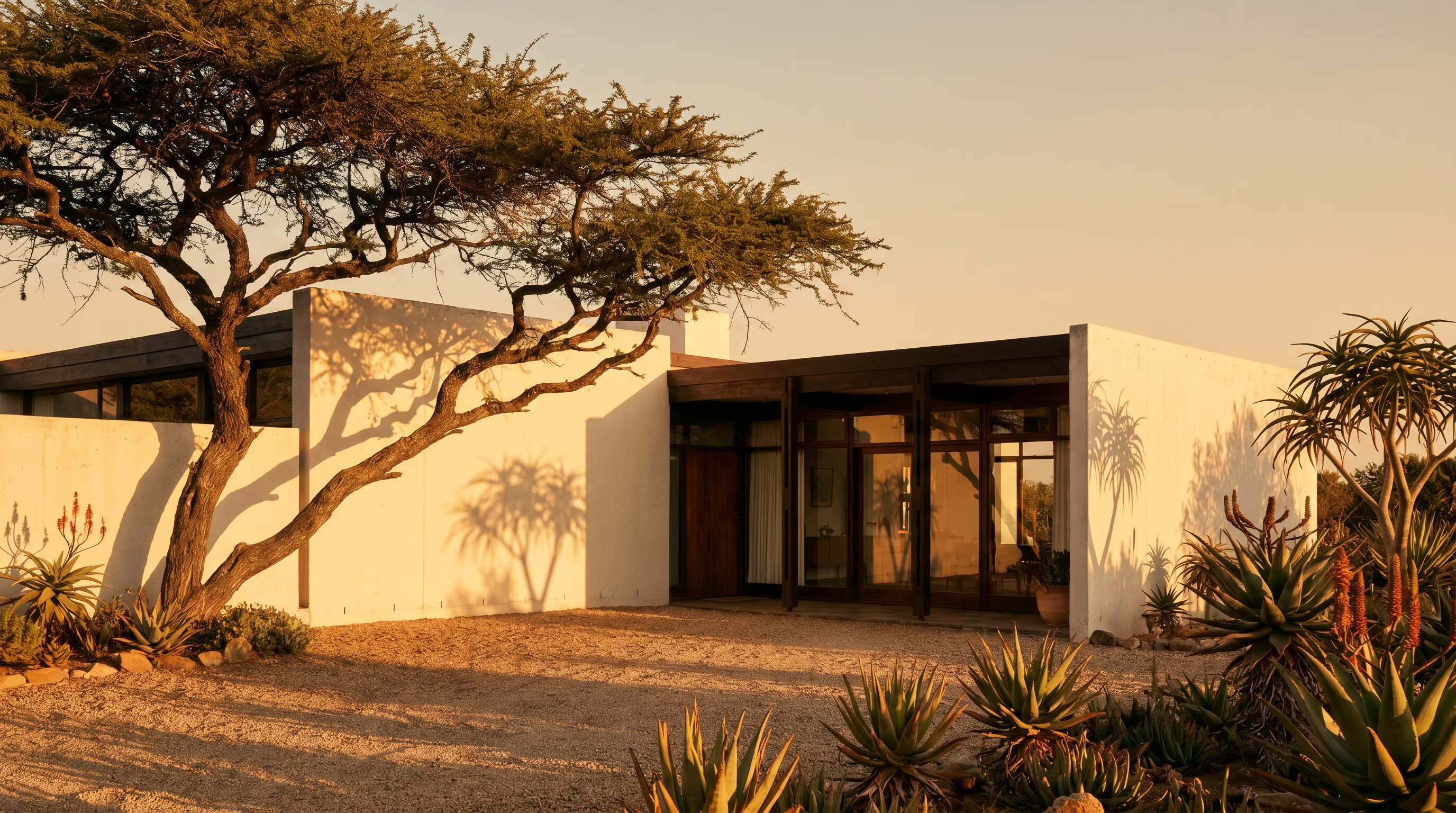
The shape of our packaging — the porcelain capsule, the dead-straight sides, the sharp 90-degree edges, the single horizontal seam line, the absence of any decorative flourish at all — is not arbitrary.
It is a quotation, deliberately, of a particular architectural lineage that has been quietly shaping a Southern African design vocabulary for the better part of sixty years: the body of work known, when it is named at all, as Cape Modernism. Most cosmetic packaging ignores this lineage because most cosmetic packaging is designed in Paris, Milan, or New York, and Cape Modernism is a regional architectural language. We work in the lineage on purpose. This essay is about why.
The architectural moment
Cape Modernism is, in the strict art-historical sense, the body of South African modernist architecture produced between roughly 1955 and 1985 — concentrated in Cape Town and the Western Cape, but with practitioners and projects spread across the country. The principal figures are Revel Fox, who designed the Telkom Tower in Johannesburg and the De Hoop Wine Estate; Gabriel Fagan, who built the influential houses on Sandhills and the restoration of Cape Dutch farmsteads in the Boland; and a handful of others — Roelof Uytenbogaardt, Norman Eaton’s later work, the partnership of Munnik Visser Black Fish.
What distinguishes Cape Modernism from the broader international modernism of the same period — from Le Corbusier’s Marseille block, from Mies van der Rohe’s Seagram Building, from the Australian work of Robin Boyd — is its specific accommodation to the Southern African landscape and climate. The buildings are not abstractions imposed on a site. They are studies in how a modernist vocabulary — the right angle, the clean plane, the structural honesty, the absence of applied ornament — can be reconciled with the realities of the Cape: the hot summer, the cold wet winter, the south-easter wind, the quality of the light, the materials available within a few hundred kilometres.
The result is an architecture that is recognisably modern but specifically of place. It uses local stone where local stone makes sense. It admits the African sun where the sun should be admitted, and shades it where shading is required. It is restrained without being austere. It is regional without being folkloric.
This is, in a sense, the same brief we set ourselves with the packaging. Modern in vocabulary. Specific to place. Restrained. Regional without being folkloric.
The buildings
Three buildings, in particular, sit behind our object.
The first is Revel Fox’s De Hoop Vineyard winery, built in stages between 1972 and 1984 in the lower Breede River valley. The structure is a series of concrete-and-stone cylinders and rectilinear blocks arranged on a slope, with the production volumes housed in the cylinders and the offices and tasting room in the rectilinear elements. The cylinders are pure form — perfect circles in plan, dead-vertical in section, no taper, no ornament, no decorative articulation of the cylinder’s surface beyond the texture of the formwork that cast the concrete. They are some of the most disciplined examples of pure-cylinder architecture in the Southern Hemisphere.
The capsule we make is, in form, a small cousin of those cylinders. The proportions are slightly different — the capsule is taller relative to its diameter than the De Hoop cylinders are — but the formal logic is the same. A circle in plan. A vertical section. No taper. No ornament. The texture of the porcelain reads, when you hold it, as analogous to the texture of cast concrete: a surface that records the process by which it was made.
The second building is Gabriel Fagan’s Sandhills House, built in 1965 on the Atlantic coast north of Cape Town. The house is a single-storey rectilinear plan, finished externally in plain whitewashed render, with deep window reveals and a single pitched roof. There is no eaves overhang. There is no decorative trim. The whitewash is matte. The reveals are sharp. The whole composition is quiet to the point of asceticism, and yet — precisely because of that asceticism — the house has a kind of weight that more decorated buildings of the same era do not. It announces itself by withholding its announcements.
This is the discipline that we tried to bring to the wordmark on the packaging. The deboss is deep enough to feel under the fingertip but shallow enough to never read across a room. The lettering is set in a contemporary editorial serif drawn for restraint — its modulated stroke and high-contrast verticals echo the rectilinear vocabulary of Cape Modernist signage from the 1960s. The wordmark does not announce. It records.
The third building is Roelof Uytenbogaardt’s Werdmuller Centre, built in Claremont in 1973 — and demolished, controversially, in 2017. The Werdmuller was a brutalist mixed-use complex of off-shutter concrete and exposed timber, organised around a series of stepped terraces that mediated between the surrounding street level and the central courtyard. It was a difficult building. It was loved by the small community of architects and design students who understood it; it was hated by the broader public who found it cold and forbidding; and it was eventually destroyed because it was too expensive to maintain and too unloved to defend.
The Werdmuller is in the design lineage of our packaging in a more oblique way. It is the building that taught us, by its loss, what the cost of asceticism is. A purely modernist object, even a beautifully-designed one, has a difficult relationship with mass appeal. It can be loved by the people who love it, and dismissed by the people who do not. We knew, when we committed to the Karoo Capsule’s level of restraint, that the object would not have universal appeal. The decision was deliberate. The Werdmuller was part of our reasoning.
The colour
The colour of the capsule — a warm, slightly weathered off-white — is not white in the modernist Le Corbusier sense, nor cream in the country-cottage sense, nor beige in the corporate-skincare sense.
It is a specific colour: Pantone 14-1108, which we have been calling internally Bleached Sand. It is the colour of the Karoo limestone outcroppings of the Western and Northern Cape after a hundred years of weathering. It is the colour of the lime-washed walls of the Cape Dutch farmsteads, when the lime has begun to settle into its final mineral hue. It is the colour of the dried clay of the Northern Cape after a heavy summer.
Cape Modernist buildings often used a pale, slightly warm rendered finish for their walls — a finish that would distinguish them, in photographs, from the cooler off-whites of European modernist work. The reason was practical. The Cape sun is harsh. A pure white wall in the Cape’s summer light is uncomfortably bright; the architects of the period found, through trial and error, that a warm-leaning off-white reflected the heat without producing the glare. The aesthetic decision was downstream of the climatic one.
The colour of our packaging is downstream of the same decision. A pure white porcelain would be cold in the bathroom light it lives in. The warm-leaning off-white sits more easily in a domestic environment, and it carries the additional benefit — for our purposes — of registering, almost subconsciously, as Southern African in feel.
The seam
The single horizontal line where the lid meets the body of the capsule is one of the few places where the object diverges from a strict Cape Modernist logic. The capsule is, technically, a two-piece object — there has to be a way to access the contents — but most cosmetic packaging hides this fact. The seam between cap and body is usually decorated, beveled, recessed, or otherwise softened.
We did the opposite. The seam is a single sharp horizontal line, articulated rather than concealed. We chose this because the Cape Modernist tradition tends to articulate its construction joints — the edge between two materials, the line between a cast section and a stone wall — rather than smooth them away. The seam is not a flaw in the form; it is part of the form’s honesty about how it was made.
Holding the capsule, the seam is the place where the eye and the hand register that the object is constructed. It is the small detail that prevents the capsule from reading as a closed monolith and instead reveals it as something assembled, openable, refillable. The seam is functional. It is also part of the object’s grammar.
Why this matters at all
It matters because the alternative — designing the packaging without a stated lineage — is what most of the cosmetic industry does, and the result is the visual sameness that has overtaken premium body care: the rounded-shoulder bottles, the soft serifs, the imitation-Aesop apothecary mood, the imitation-Le Labo industrial mood, the imitation-Glossier muted-pastel mood. None of these are bad on their own. They are, collectively, an exhausted vocabulary.
We chose a different lineage because a different lineage was available to us. Cape Modernism is regional, specific, undermarketed, and aesthetically unexhausted. It also happens to be — for a brand inspired by Southern African botanicals — exactly the right register. The architecture of the place where the plants grow is a more authentic source for the packaging language than another round of European apothecary borrowing.
The capsule does not announce its lineage. Most people who buy the product will not know that it is quoting Revel Fox, or that the seam is a Gabriel Fagan-adjacent decision, or that the off-white is climate-derived. That is fine. The capsule does not need anyone to know. It needs only to be the right object — to feel, when held, like something that was made by people who took the time to think about what kind of object it should be.
The thinking is the work. The capsule is the record of the thinking.