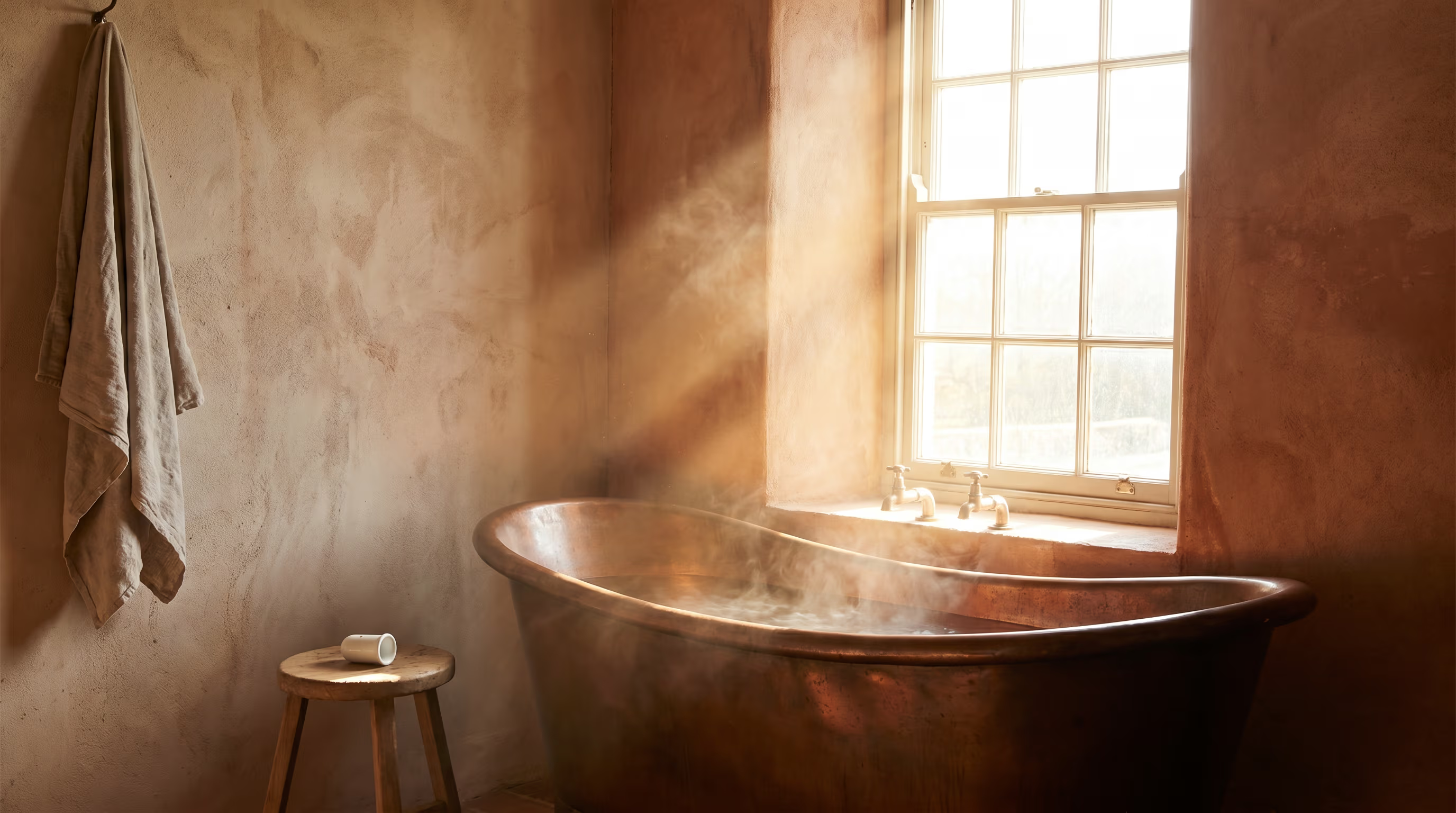
There is an art to the long bath that has nothing to do with bath products.
The bath products help. We make a magnesium soak and a fynbos bath oil and we have firm views about both. But the products are not the work. The work is the slowness — and slowness, in 2026, is harder to come by than any premium cosmetic ingredient.
This is an essay about how to take a bath. It is also, by extension, about why the bath is one of the few remaining domestic technologies for stepping out of the day.
Temperature
Hotter is not better.
The body’s thermoregulatory system reads a 38–39°C bath as warm — pleasantly so — and responds with peripheral vasodilation, slight blood pressure reduction, and a measurable parasympathetic shift. This is the response you want. It is what makes a bath feel restorative.
Above about 41°C, the response shifts. The cardiovascular system starts working harder. Cortisol rises. Skin loses water faster than it can replace it, and the lipid bilayer of the stratum corneum begins to soften and disorganise. You step out feeling drained rather than restored, and your skin feels tight for the next several hours. We have all done this. It is not the bath the body is asking for.
The 38–39°C window is also the window that supports the use most often associated with evening bathing — the gentle pre-sleep core-temperature drop that, if timed correctly, reinforces the body’s natural circadian descent into sleep. There is a 2019 meta-analysis in Sleep Medicine Reviews showing that warm bathing 1–2 hours before bed improves both sleep onset and sleep quality, with the strongest effect at temperatures around 39°C. The mechanism is the post-bath cooling, not the bath itself; warm water dilates peripheral blood vessels, the body sheds heat efficiently after you step out, and core temperature drops in a way that mimics the natural pre-sleep thermal cycle.
A bath thermometer, if you have one, is helpful. If you don’t, the test is approximate but reliable: the water should be warm enough that immersion feels good but not so warm that you flinch. If you flinch, run cold water until you don’t.
Timing
Twenty minutes.
We arrived at this number empirically, in the way that almost everyone who takes baths regularly arrives at it. Below fifteen minutes, the bath does not deliver its full restorative effect; the body has not had time to settle. Beyond about thirty minutes, the skin’s barrier begins to register the cumulative water exposure as mild stress, and the post-bath skin feel deteriorates.
Twenty minutes is also long enough to read a chapter, to do nothing for an extended duration, to listen to two pieces of music in their entirety, or to think about something that you have been deferring. It is short enough to be defensible against the rest of your evening.
The timing of when in the evening you bathe matters less than the consistency of doing it. A 9 pm bath on Tuesdays and Saturdays will do more than a sporadic late-night soak when you remember.
Sequence
The order, if you are using both a magnesium soak and a bath oil, is: dissolve the soak in the running water first, fully, before adding the oil. The salt needs water at full temperature and motion to dissolve cleanly. The oil needs to disperse over the surface, which it does best when the water is already at level and still.
This is the procedural step that makes a difference between a bath that feels considered and one that feels assembled. We use a heaped handful — about 50 grams — of Karoo Calm, stirred in a wide circle until the water is clear of crystals, followed by 2 to 3 pumps of Fynbos Sensorial Bath Oil just before stepping in.
You can also use either alone. The soak does its work without the oil. The oil does its work without the soak. The combination is for nights when the day asks for it.
What to do in the bath
This is the part that, for most modern adults, is the actual difficulty.
Twenty minutes of warm water around the body, with no obligation to perform any task, is — for many people in 2026 — almost unbearable. The phone is the most common rescue. We do not recommend the phone. The phone in the bath defeats the entire mechanism. The hormones the body is trying to reach for during a bath are antagonised by the dopamine architecture of an unread inbox.
The actual options are limited but each is good.
A book. Specifically, a book that does not require strong concentration — a novel, an essay collection, a book of poems — held above the water with the patience of someone willing to drop it. Some people use a small wooden bath caddy. Some people just hold the book carefully. The occasional water mark is the cost of the practice.
Music. Played at low volume from a speaker far enough from the bath to be safe. Quiet music, not building music. The Kankyō Ongaku tradition of Japanese ambient — Hiroshi Yoshimura, Joe Hisaishi’s quieter pieces, Midori Takada — is almost ideal for the long bath. So is most of ECM Records’ classical catalogue. Not necessary, but useful for people who find silence itself a kind of work.
Breathing. The simplest option. Four counts in through the nose, six counts out through the mouth, repeated for the duration of the bath. This is, in the breathwork literature, a parasympathetic-dominant pattern; it triggers the same vagal response that the warm water is also triggering. The combined effect is much stronger than either alone.
Nothing. The hardest of the four for most people. If you can do nothing for twenty minutes — neither read, nor listen, nor count breaths — you do not need any further bath ritual advice from anyone.
Afterwards
The first ten minutes after a bath are the window in which the bath either becomes part of the evening or becomes a thing you did before going back to your phone.
The choice that holds the bath open is small. Pat the body dry — do not rub. Apply oil to skin while it is still damp; the body oil (VV-05) absorbs more readily into hydrated skin and traps the residual moisture. Put on a soft cotton or linen robe. Move slowly into the rest of the evening. Lights low.
The choice that closes the bath is also small. Towel briskly, dress, head straight to a screen. The parasympathetic state collapses in approximately three minutes. The bath becomes one of those experiences that was good while it lasted but did not, in the end, change the texture of the evening.
This is not a moral observation. It is a practical one. The post-bath protocol is part of the bath. The brand of body oil you use is meaningfully less important than whether you use any body oil, and whether you give yourself five quiet minutes to apply it.
How often
Once a week is enough.
Twice a week is luxurious.
Three times a week is too much for skin barrier function. The cumulative exposure starts to outweigh the restorative effect, and the magnesium soak, in particular, has a slight desiccating effect on already-dry skin types when used too often.
The bath is most effective when it is rare enough to feel deliberate. A daily bath is a different practice — closer to hygiene than ritual — and not the practice this essay is about.
A note on the household
The thing that gets in the way of the long bath, more than any cosmetic concern, is the household. Children, partners, dogs, the door, the doorbell, the deliverable due tomorrow.
We do not have a solution for this. We will say, as a matter of observation, that the people we know who actually use baths regularly have negotiated a small amount of household agreement around it. Tuesday and Saturday evenings, 9 pm to 9:30 pm, the bathroom is closed. Phones are not interrupted unless someone is bleeding.
This is not the romance of self-care. It is the small, slightly awkward labour of asking the household to give you twenty minutes.
It is also, in our experience, the thing that makes the difference between a brand of bath products you own and a bath ritual you actually have.